
If you imagine retirement as one long, unchanging phase, there’s a good chance you’re planning for the wrong future.
Research from New Zealand and overseas shows that retirement spending isn’t flat rate. On average, it declines around 3% per year as people age, and it’s mostly because discretionary spending falls. This isn’t just because people run out of money, but because their lifestyle and capacity to spend changes. A simple way to understand this pattern is via the three stages of retirement: Go-Go, Slow-Go and No-Go years.

Stage 1: The Go-Go Years
What life often looks like
This is the phase many people dream about. Because health and mobility are generally good, it is far easier to stay active and engaged. Energy levels also tend to be higher, which allows retirees to travel, socialise, and pursue hobbies with fewer physical limitations. There is finally the time and freedom to focus on interests, experiences, and meaningful relationships and other responsibilities previously crowded out.
Spending patterns in the Go-Go years
From a planning perspective, discretionary spending is usually at its peak during this stage of retirement. Non‑discretionary costs such as food, utilities, rates, insurance, and transport tend to remain relatively stable, but the “fun” part of spending increases noticeably. This is the period where retirees are most likely to use and enjoy their savings – funding experiences and lifestyle choices that matter most to them.
Practical planning tips
It’s important to prioritise health‑dependent goals early on in retirement, as experiences or more physically demanding adventures are usually better done during the Go‑Go years. It can also make sense to allow for a higher discretionary budget in these earlier years by deciding how much you are comfortable spending on travel, dining out, and hobbies, knowing that these expenses tend to decline naturally over time. Finally, rules of thumb such as the 4% or 6% rule should be used flexibly, providing a framework rather than a constraint, with the understanding that slightly higher spending early on can be balanced by lower spending later in retirement.
Stage 2: The Slow-Go Years
What changes
Many people are still independent and engaged during this stage of retirement, however certain aspects of life begin to change. Long-haul travel may become less appealing and energy levels can be lower. As a result, there is often a preference for shorter trips or spending more time closer to home. Many people spend more time with close family as well as becoming more involved in their local community. Health issues may also begin to play a more noticeable role, subtly shaping how time and energy are spent.
Spending patterns
Discretionary spending tends to decline as large overseas holidays become less frequent, major lifestyle asset upgrades occur less often, and lifestyles become more settled. Non‑discretionary costs such as food, utilities, rates, insurance, and, for some, rent or mortgage payments generally remain consistent. As a result, overall spending typically drifts down from the higher levels seen during the Go‑Go years.
Practical planning tips
A gradual decline in spending is to be expected in this stage of retirement. If your spending starts to reduce, it does not automatically mean you are doing something wrong or being “too frugal”; it simply reflects that your lifestyle is changing. It is also wise to reassess your budget every few years as travel and other large discretionary expenses fall away. This review can help you decide whether some of that spare capacity could be redirected toward gifts, support for family members, or home modifications, and whether your investment strategy remains appropriate for your remaining time horizon and spending needs.
Stage 3: The No-Go Years
What life often looks like
Travel is often minimal or stopped entirely as mobility becomes more limited. Social interaction tends to shift to the home or care based setting, with fewer activities taking place outside the house. As health and independence decline, support needs may rise, which can influence daily routines and priorities.
Spending patterns in the No-Go years
Discretionary spending often drops sharply, with few holidays, less dining out, and a smaller number of discretionary purchases. Non-discretionary costs such as, food utilities, insurance, housing, and care-related expenses continue. Overall, total spending is often lower than in the earlier stages, though the mix of spending can shift more heavily toward essential and care related needs.
Practical planning tips
It is important to plan to live longer than you might initially expect. Many people still assume they won’t live much beyond their 70s or early 80s, but in reality, it is often more realistic to plan life into your 90s. Not budgeting the Go-Go spending forever is also important, as you don’t need to assume the same high travel budget in your 90s that you had in your 60s. This gives more flexibility to spend a bit more earlier on. Even as lifestyle spending declines, it is essential to allow for ongoing support costs, as care and assistance can become increasingly important in later years.
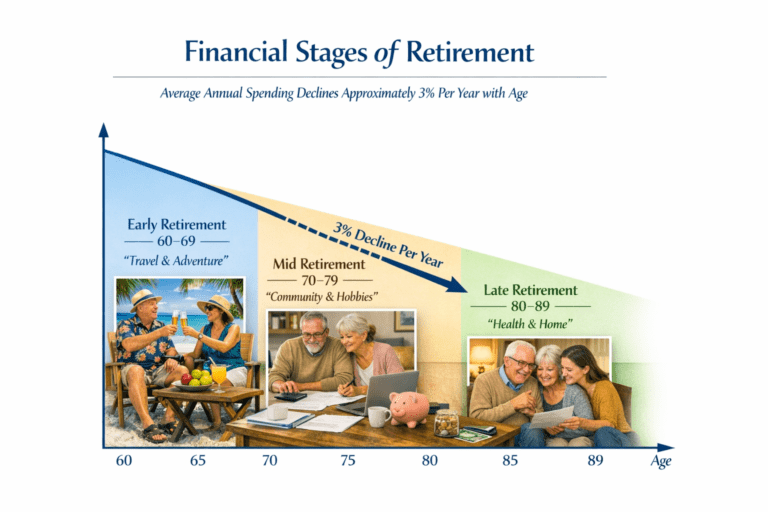
Bringing It All Together: Planning by Stage, Not Just by Age
Rather than treating retirement as a single block of 25-30 years with a flat rate of spending, consider planning by stage. This involves defining your own version of Go-Go, Slow-Go, and No-Go, assigning rough budgets to each stage, and matching your income sources accordingly. Reviewing your plan every few years allows you to adjust as your lifestyle, health, and priorities change over time
When you plan this way, you’re no longer just asking, “Do I have enough for retirement?” but a more useful question:
“Do I have a plan that matches how I’m likely to live and spend in each stage of retirement?”