
For many people, retirement is still seen as the beginning of the end.
A winding down. A quieter chapter. A gradual step away from the most meaningful and enjoyable parts of life.
But what if that narrative is wrong? What if your happiest, most fulfilling years are still ahead of you?
The Myth of Decline After Mid-Life
There’s a long-standing belief that life satisfaction, alongside our physical health, peaks in our 20s or 30s, before gradually declining as we age. By the time we reach our 50s and 60s, the story goes, the ‘best years’ are firmly behind us.
This idea has shaped how many people approach retirement:
- Prioritising living for today
- Delaying meaningful financial planning
- Assuming that later life is something to be endured
But this traditional narrative does not align with the lived experiences of many older adults, nor with what science now tells us about how happiness typical evolves over a lifetime.
The U-Curve of Happiness
In fact, the data tells a very a very different story. Across many countries and cultures, studies have found that happiness tends to follow a U-shaped curve over a lifetime.
- Higher in early adulthood
- Dips in mid-life (often late 30s to mid-40s)
- Rises again from the late 40s onwards
In other words, mid-life is often the low point, not the peak.
And from there, things tend to improve.
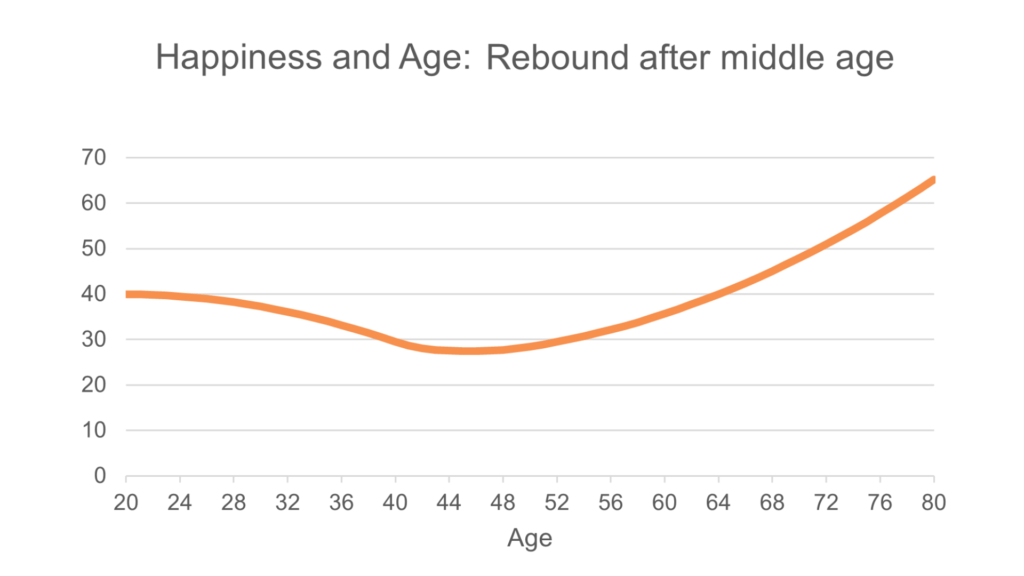
For many people, their 50s, 60s, and beyond become some of the most satisfying years of their lives.
Why Happiness Improves With Age
So what drives this upward curve in later life?
Several key factors tend to come into play.
1. Greater Emotional Resilience
With age comes perspective. We tend to manage stress better, react less to small frustrations, and focus more on what truly matters.
2. Clearer Priorities
As we become more aware that time is finite, we often become more intentional.
We invest more in relationships, meaningful activities, and experiences that genuinely matter.
3. Freedom From Mid-Life Pressures
Mid-life can be one of the most demanding stages:
- Career pressure
- Financial commitments
- Raising children
As these ease, time and mental space begin to open up again.
4. A Deeper Sense of Gratitude
Older adults often report a stronger appreciation for simple pleasures:
- Time with family
- Good health
- Everyday experiences
5. Stronger Social Connections
Contrary to common assumptions, many people build deeper and more meaningful relationships later in life—through family, community, and shared interests.
What This Means for Retirement
This changes how we should think about retirement entirely. Rather than being:
- A slow decline
- A financial endpoint
- A time to “wind down”
Retirement can be:
- A new phase of growth
- A time for reinvention
- An opportunity to design life more intentionally
But this doesn’t happen by accident
The U-curve of happiness is not a guarantee, it’s an opportunity. To benefit from it, retirement needs to be approached with intention. That means planning for more than just money.
It means thinking about:
- How you will spend your time
- What will give you purpose
- Who you will stay connected with
- How you will maintain your physical and mental wellbeing
Financial security plays an important role, but it is only one part of the picture.
If you’re approaching retirement, or even just thinking about it, it’s worth asking a different question.
Not:
“When can I afford to stop working?”
But:
“How do I design the next phase of my life so that it’s genuinely fulfilling?”
Because if the research is right, and for many people, it is, then your later years are not something to fear. They may, in fact, be the most rewarding chapter yet.
Where to From Here?
At The Retirement Guys, we believe retirement planning should be about more than just numbers.
It’s about helping you build:
- Financial confidence
- A clear sense of direction
- And a life you’re excited to live
If you’d like to explore what your ideal retirement could look like, we’d be happy to help.